Why executive cyber governance

Cyber risk is not an IT problem.
It’s a governance responsibility.

Operating technology and governing its risk are different jobs. One belongs in the server room. The other belongs at the leadership table.

Bring us the decision
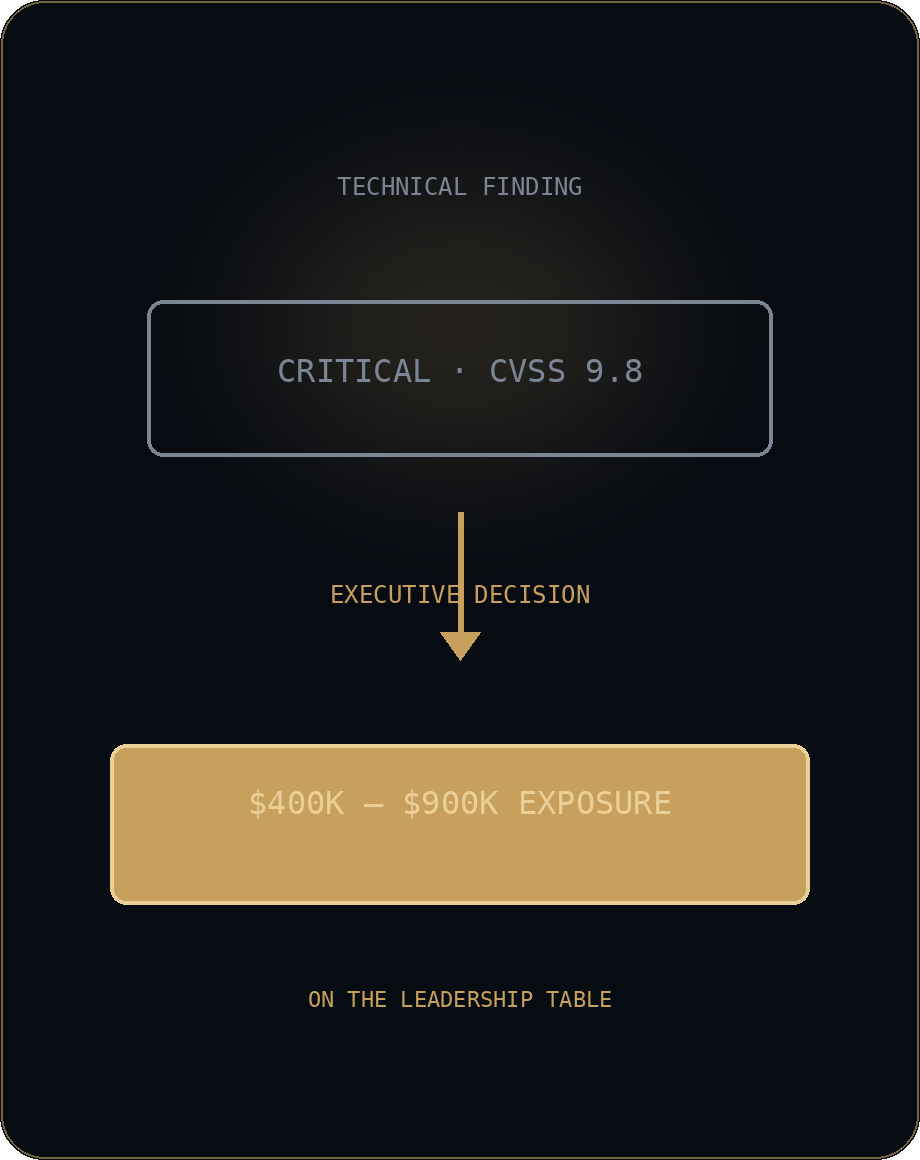
A technical finding (CVSS 9.8) translated into executive exposure in dollars
The missing seat

Your finance director doesn’t audit their own books. Your attorney doesn’t approve their own contracts. Yet in most organizations, the people operating the technology are the only ones judging its risk — with no independent voice at the executive table. That’s not a criticism of IT. It’s a missing seat.

IT operates — essential, technical

  • Keeps systems running and staff supported
  • Installs and maintains defenses
  • Responds to daily technical issues
  • Manages vendors and service tickets

Someone must govern — strategic, accountable

  • Decides which risks the organization accepts
  • Ranks what gets fixed first — and funds it
  • Briefs the board in plain English
  • Answers to regulators, insurers, and investors
The language of quantified risk

Technical findings in. Executive decisions out.

“Critical vulnerability (CVSS 9.8)”

→ This weakness could interrupt payroll for five days — estimated exposure $400K–$900K.

“Privilege escalation risk”

→ An attacker could obtain administrator control of your financial systems.

“Misconfigured cloud storage”

→ Sensitive customer information could be publicly exposed — with regulatory and legal consequences.

We are not your IT team’s replacement. We are their advocate — translating their good work into the language your board, your insurer, and your budget process understand.

Bring us the decision

Cyber risk belongs on the leadership agenda.

Next to financial controls and legal compliance — not in the server room.

Bring us the decision