Executive Outcome 02 — Fund the right risk
If we invest another $500,000 in cybersecurity, what materially changes?
Once exposure is financial, cybersecurity competes on equal terms with every other capital request. We help leadership fund the risk that matters — and defend what it doesn’t.
Review our cyber investment
Without quantification, security spend follows the loudest vendor rather than the largest exposure. The biggest risk stays unfunded, invisibly, while comfortable risks get money.
An institution that funds cyber above its expected loss while underfunding a larger exposure elsewhere has not been prudent. It has misallocated capital in a direction that felt safer.
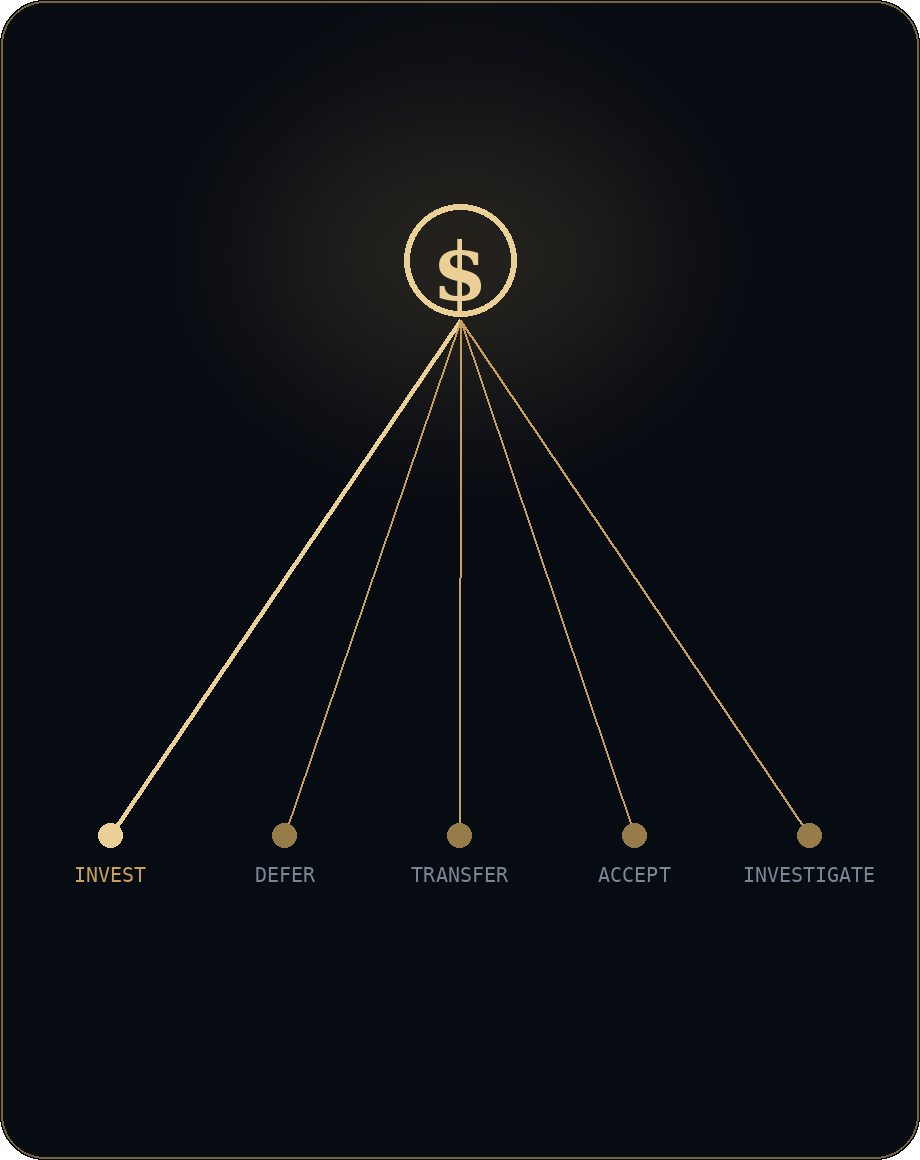
Which investments to INVEST, DEFER, TRANSFER, ACCEPT, or INVESTIGATE — and what exposure remains after the money is spent.
Investment → exposure → expected risk reduction → business capability protected → decision. Every dollar traced to what it buys down.
Proposals are compared on economic merit, not urgency — so leadership funds reduction, not anxiety.
We state what exposure remains after each investment, so the board sees what it is choosing to keep.
Where spend has weak justification, we say so. Independence means our only incentive is the decision being right.
Leadership funds the investments that produce meaningful risk reduction, defers or declines the ones that don’t, and can defend each choice with a documented economic basis. The budget stops being a negotiation and becomes a decision.
A documented basis for each material security investment — exposure bought down, cost, residual, and decision — the memo a CFO can defend and a board can approve.
If a cyber, technology, resilience, or AI decision carries material business consequence, bring us the decision before it becomes the loss.
Review our cyber investment30 minutes · Independent · Vendor-neutral · Nothing sold