Putting a dollar figure on cyber risk
Why heatmaps fail leadership, and how financial quantification changes the budget conversation.
A board cannot weigh “high cyber risk” against a $12 million operational exposure, a supply-chain disruption, or a regulatory remediation programme.
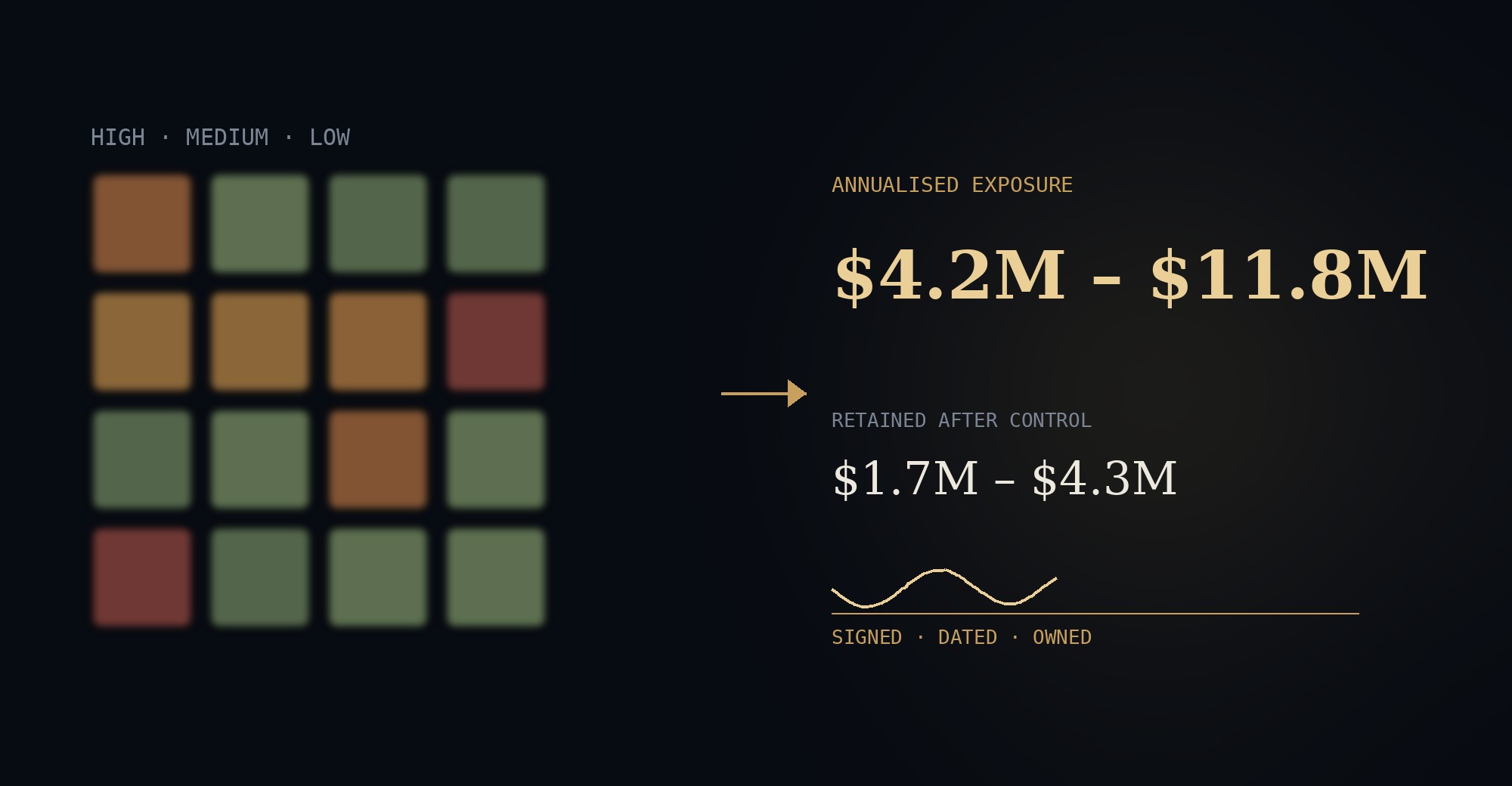
A CFO cannot allocate capital against “red”
Cybersecurity still enters executive meetings speaking a different financial language from nearly every other function in the enterprise. High. Medium. Low. Red. Amber. Green.
These are useful for sequencing security work. They are close to useless for allocating enterprise capital. The problem is not the heatmap. The problem is what leadership is asked to do with it.
Consider two risks, both rated Critical. One carries an estimated $18 million in annualised loss exposure. The other carries $900,000. Same colour on the page. Entirely different decisions. Now suppose security proposes a $2.4 million control for each. The heatmap tells leadership both deserve attention. Quantification forces the harder question:
Which of these deserves the company’s next dollar?
What quantification actually buys
Executives do not require precision. They require a defensible range and a visible chain of reasoning. Replace “Ransomware is Critical” with something a CFO can act on:
Ransomware is Critical.
Exposure: $4.2M–$11.8M
Control: $1.6M
Residual: $1.7M–$4.3M
The CFO can now challenge the assumptions. The CEO can compare alternatives. The board can see what remains after the money is spent. And the CISO can answer the question that always arrives: what did we get for it? That is a materially better conversation — but it is not the destination, and most organisations stop here believing that it is.
The uncomfortable finding
Security leaders generally adopt quantification believing it will strengthen their case for funding. It frequently does the opposite. Once cyber exposure is expressed in currency, it competes on equal terms with every other capital request. Sometimes it wins. Sometimes it loses to a warehouse-automation programme with a clearer return.
That is not a failure of the method. It is the method working. An institution that funds cybersecurity above its expected loss while underfunding a larger exposure elsewhere has not been prudent — it has misallocated capital in a direction that happened to feel safer.
The first honest quantification exercise often produces a smaller cyber budget in one area and a much larger one in another. Leaders not prepared for that outcome abandon the discipline at precisely the moment it begins to work. An organisation unwilling to accept an unfavourable comparison does not want quantification. It wants validation expressed in numbers.
Why quantification programmes actually fail
The stated reasons are methodological: insufficient data, contested assumptions, immature models. The real reason is structural.
A colour has no owner. A number does.
“Critical” can sit on a slide for three consecutive years without anyone being answerable for it. “$4.2M–$11.8M in annualised exposure, of which $1.7M–$4.3M is retained after the proposed investment” cannot. That sentence creates an obligation the moment it is written. Most quantification programmes are not killed by bad mathematics — they are quietly starved because the numbers create accountability that nobody volunteered to carry.
The Retention Signature™
Every quantified residual exposure is a retention decision. The enterprise has chosen to hold that risk on its own balance sheet rather than eliminate, transfer, or avoid it. In every other domain, such a decision carries a name — retained insurance layers are approved, credit concentrations authorised, trading limits signed. In cybersecurity, residual exposure is almost universally unsigned.
The Retention Signature™ is the named, dated, board-visible acceptance of the specific financial exposure an institution has decided to keep.
It converts an omission into a decision.
Risk retained without a signature was not accepted — it was overlooked. Those two states are indistinguishable in a heatmap and clearly distinguishable in a signed retention record.
It is defensible under examination.
When exposure materialises, the question is rarely “did you eliminate the risk?” It is “did you understand it, and did you decide?” A dated signature is evidence of judgment exercised. Its absence is evidence of judgment absent.
It reprices the debate.
Executives argue about proposed spending. They argue very differently about what they are being asked to put their name to. The signature is where the underlying assumptions are finally tested — because that is the moment someone reads them carefully.
The chain that must remain visible
A number without a visible derivation is a dashboard pretending to be certainty. Bad assumptions expressed in dollars are still bad assumptions, now carrying an unearned authority. The model must expose its own reasoning:
Cause → Risk event → Consequence → Financial loss → Control → Residual → Owner
Which is the institutional judgment chain applied to a capital decision:
Evidence → Judgment → Conviction → Decision → Accountability
The board’s test is not whether the number is right. It is whether the number can be argued with. The objective is not the perfect estimate — it is the defensible decision.
The assumptions to surface before the board approves anything
That quantification produces accuracy.
It produces comparability and traceability. Those are more valuable and more achievable.
That a range signals weakness.
A single figure signals false confidence. A wide range honestly derived is more credible than a narrow one confidently asserted.
That the model belongs to security.
Loss magnitude is a business estimate. If security is estimating alone, the number is an engineering opinion wearing a currency symbol.
That residual exposure is a technical remainder.
It is a retained liability. It belongs in the risk-appetite statement and, above a threshold, in front of the board.
That the exercise is annual.
Exposure changes with every acquisition, launch, market entry, and migration. An annual model describes an institution that no longer exists.
The tradeoffs leadership owns
Rigour against velocity.
A defensible model covering the top ten exposures at board-relevant materiality takes weeks, not months. Institutions that pursue completeness before usefulness rarely reach either.
Transparency against attribution.
Publishing exposure figures improves challenge and improves the estimates — and creates a record you will be asked about. Worth making, deliberately, with the follow-through resourced.
Comparability against protection.
Entering the capital queue means occasionally losing. The alternative is remaining outside it, funded by anxiety — a position that holds only until the first serious cost-reduction cycle.
The tail against the ordinary.
Frequent, modest losses are easy to model and rarely threaten the institution. Rare, severe events are hard to model and are the reason the board is involved. Weight the effort toward the second.
The question to put in front of the board
What financial exposure are we buying down, by how much, at what cost — and what exposure are we deliberately choosing to keep?
And then: whose name is on the part we are keeping?
If neither question can be answered, the organisation does not have a cybersecurity budget problem. It has a decision-quality problem, and additional funding will not resolve it.
What this looks like in five years
Disclosure pressure closes the gap.
Regulators, insurers, and acquirers increasingly ask for financial exposure estimates rather than maturity scores. Build the capability voluntarily, on your terms — or under deadline, under scrutiny, with far less credibility.
The estimate becomes a market signal.
Underwriting, credit, and diligence converge on one question: does this management team understand the magnitude of what it holds? A derived range is priced differently from a colour.
Retention becomes the fiduciary battleground.
As quantification normalises, “we did not know” ceases to be a defence. The question shifts from whether an institution was breached to whether it knowingly accepted the exposure through which it was breached — and whether that acceptance was made by someone with the authority to make it.
The heatmap will not disappear. It will simply cease to be admissible as the basis for a capital decision.
Cybersecurity earns its place in the capital conversation the moment it stops asking leadership to fund fear and starts offering a defensible basis for choosing where the next dollar goes.
But quantification is not finished when the number appears. It is finished when someone signs for what remains.
An institution that can state its retained cyber exposure — in currency, with a named owner and a date — has demonstrated something no maturity score can: that it made a decision rather than an omission.