A five-part instrument for boards & executive teams.
Most organizations invest in better information. Few invest in the discipline of how consequential decisions are actually made, owned, and reviewed. That discipline — not the data — is what a board is finally accountable for.

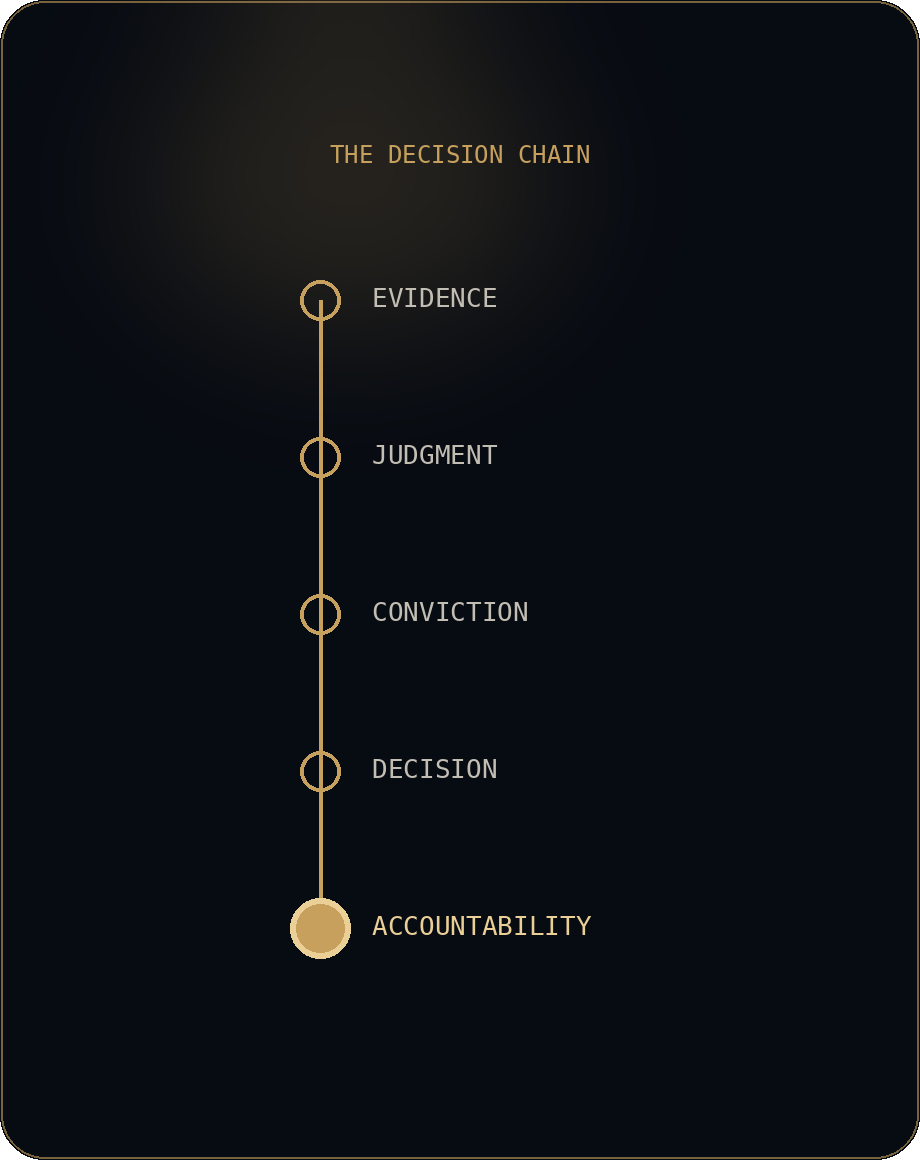
There is no direct route from data to decision.
Every link that is skipped is a link no one owns.
Verified information, separated from belief.
Interpretation of what the evidence means — not what a model outputs.
A stated reason one path is more defensible than the rejected one.
The commitment, recorded — including a decision not to act.
One named person who answers for the outcome.
Each instrument makes a different part of institutional judgment visible, measurable, and owned. Presented here in outline; the working method is delivered privately to boards and executive teams.
The five links every consequential decision must travel — and where ownership dissolves when one is skipped.
Good judgment cannot be measured directly. The conditions that produce it can — over time.
Ownership assigned at the moment of decision, not discovered after the result disappoints.
The rhythm at which decisions are revisited against what actually happened — including the ones deferred.
A single view of where the organization’s decision capability is strong, thin, or unowned.
The Institutional Decision Capability™ instrument set is delivered to boards and executive teams through a private engagement — not published in full. If your board is accountable for decisions it cannot yet see clearly, that is the conversation.
Request a private briefingBy Carlos Fuentes · Cyber Unveil International